A Problematic Priest
by Eliezer Segal
In his concluding message to Israel, as told in the penultimate chapter of the Torah, Moses addressed each of the tribes with a blessing concerning its future. Speaking to his own tribe of Levi, he prayed: “Lord, bless his might and accept the work of his hands; smite through the loins of them that rise against him and of them that hate him, that they rise not again.”
Rashi offered two different readings of this verse. The first of them focused on its violent tone, as an assurance that the priestly tribe of Levi would be granted the physical or military strength necessary to defend themselves against their foes. Moses’s blessing promised that the opponents will be eradicated totally without any chance to rise up again.
Who are those foes? Rashi says: “Those who challenge the authority of the priesthood.” It is not entirely clear if he was referring to a specific episode in biblical or post-biblical history.
Which brings us to Rashi’s second explanation.
He foresaw that Hashmonai and his sons would one day wage war against the Greeks, so he prayed on their behalf because they were few in number— a mere twelve Hasmonean sons [it is unclear where this number came from] and Eleazar, arrayed against several myriads. It was for this reason that he said, “Lord, bless his might.”
In other words, Rashi was stating that Moses’s blessing to the tribe of Levi might have been a prediction of the Hanukkah story in which the Jewish triumph was spearheaded by a family of Levite priests [kohens], known as the Hasmoneans.
Rashi was alluding here to a passage in a midrash according to which one of the twelve tribes of Israel was preordained to bring about the downfall of each of the four great empires that will subjugate Israel through history: Babylonia, Media (Persia), Greece, and Rome (Edom). In that framework Jacob’s third son, Levi, will be the one to overthrow the third empire, Greece.
These [the Greeks] are numerous in their population while these [the Jews] are but few in number. And yet the many fell into the hands of the few. To what may this be credited? To Moses’s blessing, when he said: “smite through the loins of them that rise against him.” Into whose hand does Greece fall? Into the hand of the sons of Hashmonai who stem from Levi.
An ancient Aramaic interpretive translation of the Torah —a “Targum” mistakenly ascribed to the ancient sage Jonathan ben Uzziel and usually dated to the seventh century C.E.— inserted a mystifying clause with reference to Moses’s words about “them that rise against him.” Here the Targum remarked: “let those who hate Yoḥanan the High Priest be unable to stand on their legs.” This reading is not attested in any other work of ancient Jewish exegesis or midrash. Which high priest did it have in mind, and what does it tell us about the Targum’s origin and purpose?
The patriarch of the family is designated “Mattathias son of Yoḥanan,” and the Targum might well be alluding to that Yoḥanan, though he is nowhere mentioned as an active protagonist in the Hanukkah story.
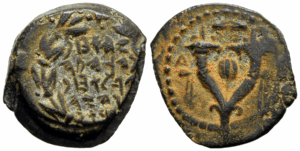
However, several prominent scholars argued that the reference is to Yoḥanan (John) Hyrcanus, grandson of Mattathias and nephew of Judah Macabbee, who served as political and cultic leader of Judea during the second century B.C.E. Hyrcanus was a controversial figure who pursued warlike policies toward Judea’s neighbours. He underwent a radical about-face on internal religious questions, switching his support from the Pharisaic sages to the priestly Sadducee party. Evidently, an addendum of this kind could only have come into existence at a time when he enjoyed the favour of the Jewish religious leadership, before his defection to the Sadducees. It has even been suggested that the Targum text might have functioned as a kind of liturgical blessing for the government when it was recited during Hyrcanus’s reign as part of the synagogue Torah reading, to plead for the sovereign’s protection from his numerous internal and foreign opponents.
Indeed, recent scholarship has argued that classical Hebrew liturgical poetry and Targums were produced in distinctive priestly circles that did not always share the perspectives of the rabbis.
This explanation would situate this Targum passage centuries earlier than the bulk of rabbinic texts that were not composed until the second century C.E. and later —and much, much earlier than the date normally proposed for the “Jonathan Targum.”
Other scholars have been less extreme in their claims, reluctant to go beyond the acknowledgment that this particular passage preserves a unique remnant from an older tradition (one that somehow eluded censorship by the Pharisees or rabbis), though the entire Targum is not necessarily so ancient. It is therefore quite understandable that some scholars simply dismissed the problematic reading “Yoḥanan” as a scribal error for what should have been “Aaron,” Moses’s brother and the founder of the Hebrew priesthood.
On the other hand, the Targum does make reference to other militant priests in its explication of Moses’s blessing to Levi. Consistent with a rabbinic tradition that the prophet Elijah was of priestly stock, identified with the zealot Pinhas, the Targum has Moses praying prophetically that the Almighty will accept “the offering of the hand of Elijah the priest, which he will offer on Mount Carmel” against the priests of Baal, and that he should “smash the loins of Ahab his enemy, and the neck of the false prophets who rise up against him.”
There are those who would argue that it is inappropriate for priests, whose main concerns should be confined to the spiritual realm, to take up arms in battle. This, however, is one of the lasting lessons of the Hanukkah story: that sometimes—all too often—it becomes necessary to contend with powerful enemies in order to create the conditions for pursuing the life of the spirit.
First Publication:
For further reading:
- Díez Macho, Alejandro, ed. Neophyti 1: Targum Palestinense ms. de la Biblioteca Vaticana. Seminario Filológico Cardenal Cisneros del Instituto Arias Montano. Textos y estudios 7–11, 20. Madrid: Consejo Superior de Investigaciones Científicas, 1968.
- Fine, Steven. “Between Liturgy and Social History: Priestly Power in Late Antique Palestinian Synagogues? 1.” Journal of Jewish Studies 56, no. 1 (2005): 1–9.
- Flesher, Paul V. M. “The Literary Legacy of the Priests? The Pentateuchal Targums of Israel in Their Social and Linguistic Setting.” In The Ancient Synagogue from the Beginning until 200 CE, edited by B. Olsson and M. Zetterholm, 467–505. Stockholm: Almqvist & Wiksell International, 2001.
- Friedman, Harris Samuel. “The Halacha in the Targum to the Torah Attributed to Yonatan Ben Uzziel.” PhD, University College London, 1999.
- Ginzberg, Louis. The Legends of the Jews. Translated by Henrietta Szold. Philadelphia, PA: The Jewish Publication Society of America, 1909.
- Meyer, Rudolf. “„Elia” und „Ahab”.” In Abraham unser Vater: Juden und Christen im Gespräch über die Bibel. Festschrift für Otto Michel zum 60. Geburtstag, edited by Otto Betz, Martin Hengel, and Peter Schmidt, 356–58. Arbeiten zur Geschichte des antiken Judentums und des Urchristentums 5. Leiden and Köln: Brill, 1963.
- Mortensen, Beverly. “The Priesthood in Targum Pseudo-Jonathan,” Vol. 4. Studies in the Aramaic Interpretation of Scripture. Leiden and Boston: Brill, 20062022.
- McNamara, Martin. The New Testament and the Palestinian Targum to the Pentateuch. Second printing, with Supplement containing additions and Corrections. Anelecta Biblica 27A. Rome: Biblical Institute Press, 1978.
- Shinan, Avigdor. The Embroidered Targum: The Aggadah in Targum Pseudo-Jonathan of the Pentateuch. Publications of the Perry Foundation for Biblical Research in the Hebrew University of Jerusalem. Jerusalem: Magnes Press, the Hebrew University, 1992. [Hebrew]
- Syrén, Roger. The Blessings in the Targums: A Study on the Targumic Interpretations of Genesis 49 and Deuteronomy 33: Amazon.Com: Books. Acta Academiae Aboensis, Ser. A, 64/1. Åbo: Åbo akademi, 1986.
- Thoma, Clemens. “John Hyrcanus I as Seen by Josephus and Other Early Jewish Sources.” In Josephus and the History of the Greco-Roman PeriodEssays in Memory of Morton Smith, edited by Fausto Parente and Joseph Sievers, 127–40. Studia Post Biblica 41. Leiden: Brill, 1994.
- Yahalom, Joseph. Priestly Palestinian Poetry. Jerusalem: Magnes Press, 1996. [Hebrew]
My email address is: [email protected]