
Weight-Watching
by Eliezer Segal
The judgement of Rosh Hashanah is often depicted as the weighing of our deeds on a scale. The imagery, of course, refers to one of those contraptions with trays or pans suspended on each of its sides so as to allow the heavier side to drop to the bottom.
During this crucial season, it is our spiritual qualities that are being weighed. Our good and bad deeds are placed on the respective trays of the scale. If the meritorious deeds outweigh the sins, the individual is pronounced innocent, but if the sins press their tray downwards, then the individual will be condemned to an unpleasant fate.
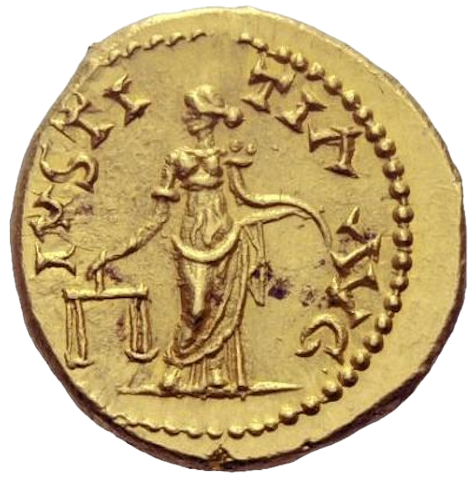
Among non-Jewish contemporaries of the talmudic sages, the symbolic personification of Justice as a lady holding a scale achieved prominence during the reign of Augustus Caesar, and a temple to Justitia was established by Tiberius. Vespasian and other emperors minted coins on which she was shown sitting on a throne holding up the scale to symbolize their roles as protectors of justice.
The Talmud recommends that everybody should imagine themselves as if they were exactly on the borderline, half guilty and half meritorious, so that the performance of just one mitzvah or transgression will tip the scale’s balance whether to the side of merit or of guilt, for one’s individual’s destiny—or even for the entire universe!
But there is some good news in store for us imperfect mortals. The supreme Judge does everything in his infinite power to rig the process to our advantage. The sages of the Talmud adapted this idea to the scale metaphor, understanding that God tweaks the mechanism so that our good deeds will outweigh—or at least seem to outweigh—our sins.
The prooftext for this idea was a verse in the book of Psalms that addresses the awesome mysteries of divine providence: “Your righteousness is like the highest mount, your justice like the great deep: O Lord, thou preservest man and beast.” The talmudic rabbis understood the Hebrew root that translates as “righteousness”—ṢDḲ—in the sense of “mercy” (as in “tzedakah”), creating a contrast between God’s two modes of relating to his creatures.

The third-century Babylonian sage Rav Judah expounded the verse as teaching that, were it not for God exercising his mercy toward us, “who could ever withstand the depths of thy judgment?” His student Rabbah reversed the causal relationship between the two clauses and interpreted them as saying: because of the depth of thy judgment, “thy mercy is like the highest mount.”
The Talmud equates this arcane dispute with a different disagreement between two scholars in the land of Israel: “Rabbi Eleazar says that God presses down and Rabbi Yosé bar Ḥanina says that he lifts up.
Rashi’s commentary explained that the allusions to lifting and pressing refer to the scales of justice when mortals are brought to judgment before the heavenly tribunal. According to Rabbah and Rabbi Eleazar, “when a person’s deeds are evenly divided [between good and bad], the Almighty grabs hold of the sins and presses them down into the depths of the sea” removing them from the record in order to tip the balance in favour of exoneration.
According to the opposing position of Rav Judah and Rabbi Yosé bar Ḥanina, God “places his hand beneath the sins and lifts them upwards, so that the merits [which now drop to the bottom] will appear to outweigh the liabilities.”
Is there any deeper significance to these differing explanations of divine tampering with the scales of judgment?
Well, for one thing, each one is focussed on a different scriptural text. The idea of “lifting” iniquities is derived from the “thirteen attributes of divine mercy” in Moses’s prayer for forgiveness, where God is said to “bear [or lift] iniquity.” The image of “pressing” the scale fits better with the mention of the “great deep” in Psalms, and with the prophet Micah’s assurance that God will “cast all their sins into the depths of the sea.”
In the eighteenth century, Rabbi Jacob Reischer proposed that the talmudic dispute reflects fundamental ideas about the moral underpinnings of the universe. A midrashic tradition noted that the opening chapter of the Torah refers to God by the divine name that is understood to designate his standard of strict justice; but later, when speaking about the creation of humans, it combines the two names that designate both justice and mercy. The sages concluded from this that at first he had considered creating the world only according to the standard of justice, but afterwards, realizing that humanity could not live up to that demanding standard, he tempered it with mercy. This, argued Rabbi Reischer, is reflected in the thesis that the initial default position of the scale is tilted towards a guilty verdict, which can only be counteracted by removing some of the sins and “casting them into the sea.”
There is however an opposing view—that mercy always had priority over justice in God’s blueprint of creation. Based on this belief, Rav Judah and Rabbi Yosé bar Ḥanina expressed appreciation to the Almighty for tilting the scales in favour of us fallible mortals. According to this approach, the scales were never predisposed toward guilt; for if they were, none of us could survive strict divine judgement.
A different perspective was offered by Rabbi Isaiah Horowitz in his influential Sh’nei Luḥot he‑B’rit. He understood the talmudic sources not only as descriptions of the heavenly procedures for adjudicating human conduct, but as guides for imperfect humans who are seeking to repent and improve their moral qualities. Such people, even those who are already very virtuous, should humble themselves in their own eyes by downplaying their merits and highlighting their sins. When humans underrate their successes and emphasize their faults, they evoke a complementary response in the heavenly court.
It is of course to be hoped that we all prove genuinely deserving of a favourable verdict by virtue of our actual merits, with no need to tamper with the scales of judgement.
First publication:
- The Alberta Jewish News, August 25, 2026, p. 47.
For further reading:
- Gries, Ze’ev. Conduct Literature (Regimen Vitae). Bialik Institute, 1989. [Hebrew]
- Kisch, Bruno. Scales and Weights: A Historical Outline. Yale Studies in the History of Science and Medicine 1. New Haven: Yale University Press, 1965.
- Urbach, Efraim Elimelech. The Sages, Their Concepts and Beliefs. Translated by I. Abrahams. Cambridge, MA: Harvard University Press, 1987.
- Shilo, Shmuel. “Ha-Rav Ya‘akov Raisher Ba‘al ha-Sefer Shevut Ya‘akov: Ha-Ish Bi-Zemano li-Zemano veli-Zemanenu?” Asufot: Annual for Jewish Studies 11 (1998): 65–86.
- Shochat, A. “On Joy in Hassidism.” Zion 16, nos. 1–2 (1951): 30–43.
- Wolfson, Elliot R. “The Influence of Luria on the Shelah.” Jerusalem Studies in Jewish Thought 10 (1992): 423–48. [Hebrew]
My email address is: [email protected]