

Dippings and Delicacies
by Eliezer Segal
Toward the beginning of the traditional Passover seder, it is customary to partake of a green vegetable dipped in salt water.
As is the usual case when we enjoy food, this act is introduced by a blessing expressing our appreciation to the “creator of the produce of the earth.” In the standard listing of the parts of the seder, this segment is referred to as “Karpas.” The word, likely of Persian origin, is variously identified as parsley, celery or other green vegetables.
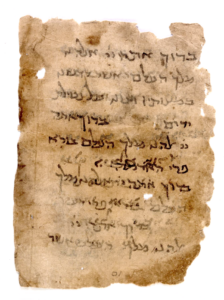
A twelfth-century Haggadah from the Cairo Genizah, the oldest such surviving text, does not contain instructions for the seder, although it is generally not difficult to reconstruct the actions that are supposed to accompany the words of the liturgy. Here, however, the matter is not so simple. Following the Kiddush, it inserts the blessing for ritual washing of the hands. This conflicts with our prevalent practice of washing without a blessing.
After the handwashing, the manuscript inserts a number of blessings specifically related to eating the Karpas, such as the expected “Blessed are you…who creates the produce of the earth.”
But there is more— The Genizah Haggadah also includes the blessing over fruits: “…who creates the fruit of the tree.” This implies that the Jews who followed this rite were eating foods other than green vegetables.
The manuscript then inserts several additional blessings, including more poetic texts, such as: “…who has created mountains and valleys and planted in them trees and all manner of fruit. Blessed are you, Lord, for the land and for the fruit of the tree,”; and “who created various kinds of delicacies with which to enhance many living persons.” It is probable that these blessings were meant to be recited after eating the Karpas, though the dominant procedure now is not to recite a closing blessing—and in any case, the accepted text for such a blessing is very different from the ones in the manuscript.
Some scholars deduce from this that there were four separate dippings: for vegetables, fruit, a flavoured rice dish, and for meat or eggs.
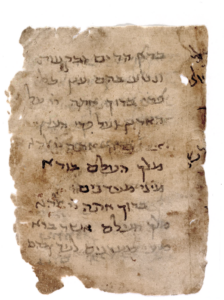
My own understanding is that it was not necessary to consume all those dishes, but merely that vegetables, fruits and other types of “delicacies” were each acceptable options. The important thing was that the participants should dip something before convening the main meal. This is consistent with the central motif of the seder as outlined in the Mishnah and other ancient rabbinic sources, that it is to be modelled after an aristocratic banquet (the prototype of freedom) at which the guests were offered hors d’oeuvres to dunk prior to reclining at their tables for the serious dining. Although it was common at such feasts to distribute lettuce, parsley and other greens, any suitable appetizer would suffice to express the idea of freedom.
We are all familiar with the clause in the “four questions” that points out how “on all other nights we do not dip even once, but on this night we dip twice.” This is not quite how the line appears in the Mishnah. In the original version, the contrast is between a single dip on regular nights and a double-dip on Passover. This attests to the fact that in ancient society it was customary to nibble on at least one dipped hors d’oeuvre at any respectable dinner, not just at religious ceremonies. Our amended version about “not even once” was introduced at a later age after such dipping had gone out of fashion.
In the Mishnah it states cryptically that following the Kiddush “one dips with ḥazeret until one gets to the appetizer that accompanies the bread.” It is clear that “ḥazeret” there refers to lettuce, which was a favourite choice of appetizer in the ancient Mediterranean. The Roman author Martial, a contemporary of the Jewish sages whose views were embedded in the Mishnah, wondered why the fashion had changed in recent years: “Tell me why lettuce, which used to be the last item of our ancestors’ meals, now opens our feasts?!”

A complication arose in the Passover context because lettuce was also the vegetable that the rabbis identified as maror, the “bitter herb” that the Torah requires in commemoration of the bitterness of slavery. When Passover was celebrated in the Temple, the recitation of the Haggadah was probably conducted following the sacrificial meal. After the Temple’s destruction, however,the order was reversed and the festive meal—minus the lamb—was moved to the slot that it occupies in the current traditional practice, after the recitation of the Haggadah. This created a considerable delay before anyone could eat. The sources attest that other foods, such as garden beets or meat, were eaten as the pre-seder snack.
Some scholars have suggested that the combined factors of pre-dinner hunger, the presence of lettuce at the table for maror, and the widespread custom of dipping lettuce appetizers at formal banquets brought about the custom of nibbling some of the lettuce at the beginning of the seder. This led to considerable confusion about why we eat lettuce twice at the same meal (as asked in the Four Questions), which of those occasions was the primary one for fulfilling the precept of maror, and what blessings should accompany them. If the first dipping fulfilled the obligation of maror, why did it have to be eaten again during the meal? It is probable that these difficulties led to the implementation of the current practice (ascribed to a rabbi in the late talmudic era) of using non-lettuce Karpas for the first dip.
The Talmud explained that ḥasa, usually identified as romaine lettuce, was chosen as the preferred vegetable for maror because “it is tender at first and hardens in the end. So too, it was with the Egyptian exile, which initially [e.g., in the time of Joseph] was gentle but ultimately became harsh.”
Therein lies a cautionary lesson that can be taken to heart by Jewish communities who have felt secure in the comfort of their diasporas.
First publication:
For further reading:
- Aptowitzer, Victor. “Fragment d’un Rituel de Pâque originaire de Palestine et antérieur au Talmud.” Revue des études juives 63, no. 125 (1912): 124–28.
- Feliks, Yehuda. Plants & Animals of the Mishna. Marʼot ha-Mishnah. Jerusalem: ha-Makhon le-ḥeḳer ha-Mishnah, 743. [Hebrew]
- Goldberg, Abraham. “Palestinian Law in Babylonian Tradition, as Revealed in a Study of ‘Pereq ‘Arvei Pesaḥim.’” Tarbiz 33, no. 4 (1964): 337–48.
- Goldschmidt, E. D. The Passover Haggadah: Its Sources and History. Jerusalem: Bialik Institute, 1969. [Hebrew]
- Greenstone, Julius. “A Fragment of the Passover Hagadah.” Zeitschrift Für Hebraeïsche Bibliographie 15 (1911): 122–23.
- Löw, Immanuel. Die Flora der Juden. Hildesheim: Gd. Olms, 1967.
- Stein, S. “The Influence of Symposia Literature on the Literary Form of the Pesaḥ Haggadah.”
- Tabory, Joseph. Jewish Festivals in the Time of the Mishnah and Talmud. Jerusalem: Magnes Press, 1995. [Hebrew]
- ———. “On the History of the ‘First Dipping’ (Karpas) on Passover Eve During the Period of the Mishna and the Talmud.” Bar-Ilan: Annual of Bar-Ilan University 14–15 (1977): 70–78. [Hebrew]
- Zeitlin, Solomon. “The Liturgy of the First Night of Passover (Continued).” The Jewish Quarterly Review 38, no. 4 (1948): 431–60.
My email address is: [email protected]
