
To Boldly Go…
by Eliezer Segal
Jewish religious thinkers have proposed many reasons for God’s choice of the people of Israel to be the recipients of the special gift that is the Torah. The second-century C.E. teacher Rabbi Meir suggested that it was “because they are ‘azzim, a Hebrew word [singular = ‘az] that can be translated as: strong, bold or even brazen.
As some of the commentators pointed out, Rabbi Meir’s comment seems to have been inspired by the verse in Psalms “The Lord will give strength [‘oz] unto his people.” which was expounded as an allusion to the giving of the Torah. Hence it is appropriate that the gift of ‘oz should be bestowed upon a community of ‘azzim.
The implication of Rabbi Meir’s statement is that Israel’s boldness was a praiseworthy quality that rendered them worthy of a special reward. This is consistent with a similar teaching that the Talmud ascribed to the academy of Rabbi Ishmael, who expounded Moses’s words in Deuteronomy “from his right hand went a fiery law for them,” as if the Almighty were saying: “these people are worthy to be given a fiery law.”
Rashi, however, had a surprisingly different understanding of the passage. According to his reading, Israel’s boldness was a negative and dangerous trait that had to be restrained. They would have remained ungovernable and unruly had the law of the Torah not been imposed upon them to temper their strength and subdue their passions.
So why did Rashi propose an interpretation that seems to be at odds with the simple message of the talmudic sages?
One possibility that comes to mind is that the Israelites do not come across as particularly bold in the scriptural narrative. They had to be pushed to follow Moses’s leadership and accept their liberation from Egypt; and their conduct was marked by unceasing griping, whining and backsliding.
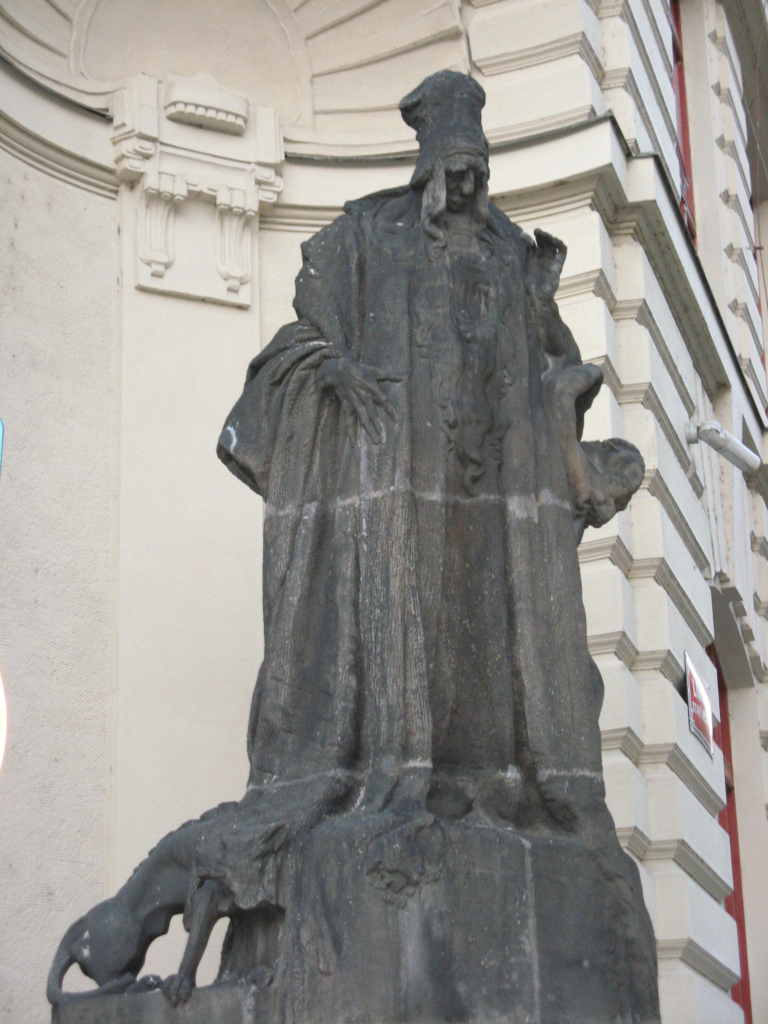
In the seventeenth century, Rabbi Loewe of Prague (the Maharal) diagnosed this boldness as an inclination to disobey rules and indulge in evil behaviour. The nineteenth-century scholar Rabbi Naftali Zvi Berlin also observed how the Israelites displayed a continual unwillingness to subject themselves to divine providence and to the commandments.
In a similar spirit, Rabbi Ephraim Luntshits expounded Jacob’s admonition to his hotheaded sons Simeon and Levi “Cursed be their anger, for it was fierce [‘az].” Their boldness, if allowed to increase in isolation, would lead to acts of violent evil. For that reason the patriarch prophesied, “I will divide them in Jacob, and scatter them in Israel,” thereby diluting the threat by not assigning them separate tribal territories in the holy land.
More specifically, the Talmud inserted a comment that “had the Torah not been given to Israel, no people or nationality would be able to withstand them.” This supports the idea that the Torah was intended, at least in part, to rein in their physical or military strength. This theme of a trade-off between religious study and physical prowess is found elsewhere in rabbinic tradition, as in the legend about Rabbi Simeon ben Lakish who was depicted as a reformed gladiator whose conversion to the life of Torah scholarship transformed him into a weakling. At any rate, this might have persuaded Rashi that receiving the Torah at Sinai was also designed to enfeeble the people physically.
This view also required Rashi to give a rather unconvincing explanation of the “fiery law” text, so that it was not the Torah that was fiery, but the volatile behaviour (“law”) of the people.
Rabbi Jacob Reischer argued that Rabbi Meir was not really asking about the main reason God gave the Torah to Israel. Obviously it was in order to provide an opportunity to accumulate merit by performing the 613 commandments! Rather, the question related to the intense study of the Torah’s theological foundations over which Jews are required to meditate day and night, and not confine themselves to a passive mastery of the rules that are relevant to practical observance. This regimen has the effect of diminishing their physical strength and boldness, making them more vulnerable to their enemies. The only solution to this dilemma is to endow them with peace. Thus there is a trade-off between: “the Lord will give strength [‘oz] unto his people,” and “the Lord will bless his people with peace [shalom].”
Several commentators expressed a more approving perspective on Israel’s boldness.
Rabbi Jacob Falk in his Penei Yehoshua observed how the rabbis generally praised the biblical Israelites for their valiant readiness to accept the Torah although it had been refused by the other nations: “In my humble opinion it appears that Rabbi Meir concluded for that very reason that it was on account of their boldness. For it is not a pejorative expression (God forbid!) intended to cast aspersions on Israel who are the holy seed, the tribes of Jeshurun, the children of Abraham, Isaac and Jacob.”
Like some other commentators Rabbi Falk invoked the famous words of Rabbi Judah ben Tema “Be bold [‘az] as a leopard to carry out the will of your father in heaven.”
He explained that this was particularly true about learning Torah, concerning which the rabbis had stated that a person who is overly timid and lacking in intellectual boldness makes a poor student. This leopard-like courage set Israel apart from the superficiality of the other nations who were not bold enough to seek out the deepest truths of the Torah.
Rabbi Luntshits as well could not resist arguing an alternative viewpoint to Rashi’s. Whatever negative issues might arise with respect to the qualities of boldness or stubbornness, we cannot disregard their positive aspects, as exemplified in Judah ben Tema’s maxim.
For obstinacy can also be a laudable quality for Israel, when it inspires us to stand up for our traditions, and to resist pressures to repudiate our values and identity.
First publication:
For further reading:
- Bettan, Israel. “The Sermons of Ephraim Luntshitz.” Hebrew Union College Annual 8/9 (1931): 443–80.
- Leibowitz, Nehama. 1972. Studies in the Book of Genesis in the Context of Ancient and Modern Jewish Bible Commentary. World Zionist Organization, Dept. for Torah Education and Culture.
- Mack, Hananel. 2001. “Who Is Responsible for the Rape of Dina?” Dappim: Research in Literature 13: 183–206. [Hebrew]
- Safrai, Ze’ev. Mishnat Eretz Israel: Tractate Avot (Neziqin 7): With Historical and Sociological Commentary. Mishnat Eretz Israel Project, 2013. [Hebrew]
My email address is: [email protected]