Being There
by Eliezer Segal
Our generation has it easy when it comes to understanding the geography of the Bible. Many of the place names in the Hebrew scriptures still bear their original names. In cases of doubt, it is easy to open up a printed atlas or consult Google Maps.
This was not true for Jews during the medieval era. Few of them had first-hand familiarity with the contours of the holy land, whether in their own time or as it had been in the days of ancient Israel. Most scholars had to infer the geographical realities from careful study of the information contained in the scriptures.
Some place names were easier than others to identify, since they appeared in narratives that described their locations or surroundings. However, in some other cases, the texts only provided long lists of names—as in the detailed catalogues of towns and sites that make up the tribal borders enumerated in the book of Joshua.
Take for example the case of Rachel’s Tomb. Every modern traveler to Israel will be familiar with the vaulted structure that stands on the road extending south from Jerusalem towards Bethlehem in what became the territory of Judah. That elaborate building was in fact constructed by the Muslims in the fifteenth century, though the site had been a focus of pilgrimage for Jews and Christians since ancient times.
This identification corresponds with the narrative in Genesis according to which the matriarch “was buried on the way to Ephrath, which is Bethlehem.” (The domains of the respective tribes were delineated by Joshua well after Jacob’s time.) The book of Ruth also states that Elimelech, Naomi’s husband, hailed from “Bethlehem Judah.”
However, other biblical texts suggest different locations for Rachel’s grave. Thus, in 1 Samuel, in the story about Samuel’s choosing Saul as Israel’s first monarch, he instructs Saul, who is searching for his father’s lost animals: “thou shalt find two men by Rachel’s grave in the border of Benjamin at Zelzah.” The territory of Benjamin is to the north of Judah; and evidently the two met in nearby Ramah which lies in that region. This is a considerable distance from Judean Bethlehem.
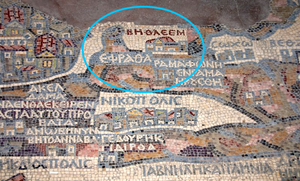
The rabbis of the midrash engaged in an ongoing dispute over which location of Rachel’s tomb is the true or primary one, the southern option in Judah or the northern option in Benjamin. Indeed, they report that the apparent contradiction was a favourite debating point for heretics who wanted to discredit the Jewish tradition.
Medieval Jewish exegetes in the diaspora did not have a very clear picture of the realities of geography or of the distances involved. Many of them inferred from the texts that the tomb could be situated both near Bethlehem and in the domain of Benjamin.
Regarding Jacob’s expression of regret to Rachel’s son Joseph for the fact that his mother could not be brought to burial in the family tomb in Hebron, Rashi has the patriarch saying “I did not carry her even the short distance to Bethlehem to bring her into the land.” The implication was that Rachel’s burial place lay outside the borders of the holy land.
Rabbi Moses Nahmanides [Ramban] initially sided with Rashi in the Torah commentary that he composed in Catalonia. However he changed his position (on this and other questions) after his immigration to the holy land in 1267. As regards Rachel’s grave he wrote: “…This is what I wrote initially, but now that I have merited to come to Jerusalem, praise to God the good and beneficent! I have seen with my own eyes that the distance between Rachel’s burial place and Bethlehem is not even one mile.”
The desire for physical familiarity with the contours of the holy land is most evident in the career of Rabbi Isaac Estori ha-Parḥi. Unlike the numerous tourists—Jewish, Christian and Muslim—who chronicled their brief visits to the standard pilgrimage sites, this native of Provence was determined to acquire a tangible experience of life on ancestral Jewish soil, especially in relation to the observance of precepts that were to be observed there, and the determining of the land’s halakhic borders. He was proficient in Hebrew, Latin and Arabic. Parhi’s magnum opus Kaftor va-Feraḥ (“Knob and Flower”) is based on seven years (1315–1322) of exploring sites that were far off the beaten track. He established his residence in Beit Shean in the Galilee, which was a thriving economic centre under Ottoman rule, after deciding that the community in Jerusalem was too quarrelsome and inhospitable to enlightened thinkers like himself.

We find a similar pattern with respect to another biblical instance of two localities bearing the same name. A Mount Hor (Hor Hahar) stands to the south of the land of Israel, bordering on Edom, and is well known as the place where Moses’s brother Aaron died. Another Mount Hor, mentioned more frequently, is designated as the northwestern border. Rashi and the other traditional commentators agreed that these were two different places; however it was difficult to identify the northern Mount Hor, an identification that was relevant for implementing the laws that are in force in the holy land. Rashi suggested that the peculiar double name Hor Hahar [= “Mount Mountain”] referred to its two-scoop shape. The talmudic tradition equated it with a certain Mount Amanus; and eminent commentators tried their hands at identifying it with various known mountains in the region.
“I toiled at great length until I succeeded with much difficulty in locating it, thank God,” concludes Estori. He provides meticulous listings of Arab villages in the region, along with detailed accounts of the topography and flora. Only one hill fit all the criteria for the identification. He could not have made his decision without first-hand experience of the terrain.
In our days of speedy travel options, when it is possible to visit many of those sites without undue toil or difficulty, there is a lot to learn and enjoy from booking a flight to Israel and walking along those ancient paths.
First publication:
For further reading:
- Elitzur, Yoel. “Ḳol be-Ramah Nishma‘ u‑She’elat Ḳevurat Raḥel.” Sh’ma‘atin 59 (1980): 16–21.
- Luncz, Abraham Moses, ed. Caftor Va-Pherach par Estori ha-Parchi. Nouvelle édition. Vol. 1. Collection d’Ouverages sur l Palestine 1. Jerusalem: [Editor’s Press], 1897. [Hebrew]
- Ofer, Yosef, and Jonathan Jacobs. Naḥmanides’ Torah Commentary Addenda Written in the Land of Israel. Eshkolot. Jerusalem: Research Institute of Herzog Academic College and World Union of Jewish Studies, 2013. [Hebrew]
- Praver, Joshua. “R’ Eshtori HaParḥi—Rishon le-Ḥoḳerei Ereṣ Yisra’el.” In Eretz Shomron, edited by Joseph Aviram, 106–13. Jerusalem: Israel Exploration Society, 1973.
- Sarna, Nahum M. Genesis—Be-Reshit: The Traditional Hebrew Text with New JPS Translation. 1st ed. The JPS Torah Commentary. Philadelphia: Jewish Publication Society, 1989.
- Shneor, David. “Geographical Descriptions of Eretz Israel in ‘Kaftor VaFerah’ Compared to Geographical Explanations of Medieval Exegetes.” Cathedra: For the History of Eretz Israel and Its Yishuv, no. 143 (2012): 93–110. [Hebrew]
- Yaari, Abraham, ed.Mas‘ot Eretz Yisra’el: Shel ‘Olim Yehudim Mimei ha-Beinayim ve‘ad Reshit Yemei Shivat Tziyon. Ramat Gan: Masadah, 1976.
My email address is: [email protected]